Human
resources
Tharisa's employees are the heart of its business and operations. Employees are vital to the Group's success and crucial to its future. Aligning individual growth to corporate growth fosters a positive environment in which all individuals seek to be part of the Group's success.
Employees
To ensure that Tharisa Minerals has the right people in the right roles doing the right work, employees are efficient, effective, engaged and attuned to the culture and values of the organisation. Various workshops have been held with the senior and middle management to discuss Tharisa's strategy. These meaningful engagements resulted in the formulation of departmental goals to assist the company in attaining planned volumes, and to increase recoveries of PGMs and chrome to 85% by 2020.
Subsequent to the announcement that Tharisa Minerals was to implement its vision of becoming an owner miner, the historic BMI and MCC employees situated at the Tharisa Mine were transferred to Tharisa Minerals' business as from 1 May 2017 and 1 October 2017, respectively. Post the transfer of employees, AMCU was recognised as the majority trade union in November 2017. Tharisa Minerals and AMCU have concluded a two-year wage agreement, post the financial year end.
Human Resources Development ('HRD')
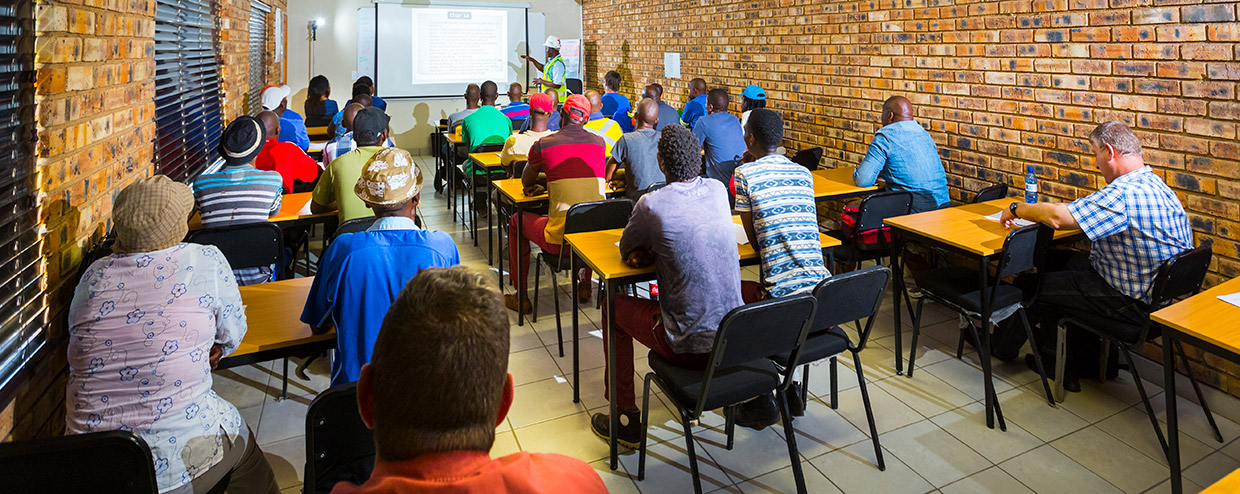
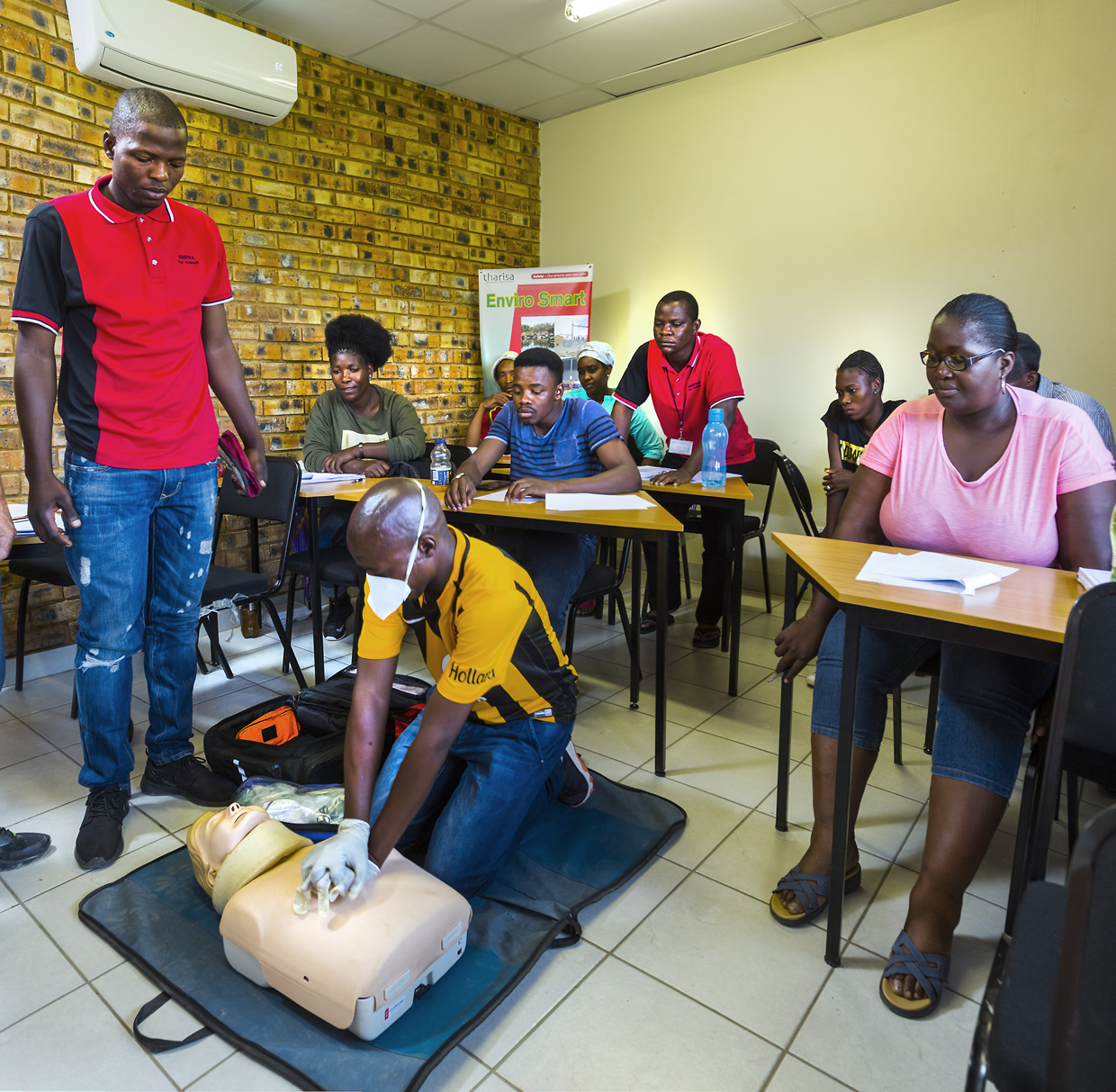
In line with its vision to train and develop a world-class workforce, the Tharisa Minerals' Human Resources Development ('HRD') department has been accredited to provide industry and nationally recognised training by the Mine Qualification Authority ('MQA'), as well as ISO 9001:2015 certification. The training centre facilities have been upgraded to computer-based training ('CBT'). Employees' history of learning and competency status is monitored and evaluated on a constant basis.
Built on the previous years' successes, the SLP component of adult education and training ('AET') has grown from 64 learners to 82. Community members' stipends of ZAR5 000 are paid to learners who pass two mandatory learning areas for each level in line with the MQA guidelines.
The majority of the Tharisa Minerals' employees have approved individual development plans. Tharisa Minerals' culture, processes and procedures are maintained through structured interventions like the A - B - C of mining, mineral processing programmes and soft skill programmes such as "Care and Growth". Standard operating procedures ('SOPs') are conducted by CBT.
An integrated HRD programme has been formulated and implemented to maximise the productive potential of people employed at Tharisa Minerals through the following initiatives:
- the A - B - C of mining
- mineral processing skills programmes - including mathematics and science
- AET programmes
- soft skills
- engineering learnerships
- internships and bursaries.
AET training
Tharisa promotes adult education training ('AET') to assist its employees in becoming literate and proficient in terms of language and numeracy. AET programmes have been implemented for employees within Paterson Grading A and B. AET classes provide employees with opportunities for either learning or improving their education levels up to AET level 4 (NQF level 1) and are compliant with the set standards of the MQA. Classes are available outside of working hours. The table below sets out the programmes facilitated in the AET trainings:
| AET level | Courses | Duration |
| Level 1 | Mother tongue, English and numeracy | One year |
| Level 2 | English and mathematics | One year |
| Level 3 | English and mathematics | One year |
| Level 4 (NQF level 1) | English and mathematics | One year |
The table below states the AET enrolment statistics for both own employees and community members in FY2018:
| AET level | Enrolments | Completed |
| Level 1 | 31 | 28 |
| Level 2 | 26 | 24 |
| Level 3 | 22 | 18 |
| Level 4 (NQF level 1) | 23 | 12 |
Skills programme
Tharisa Minerals is passionate about improving the skills and knowledge of its employees, and has consistently demonstrated compliance with legislation by submitting workplace skills plans and annual training reports timeously over the past two years. This year Tharisa Minerals spent 5.0% of its wage bill on training and development, an amount of US$3.3 million. This spending included training in SOPs and is well above South Africa's regulatory requirement of 1.0% of a company's total salaries or wage bill to be paid to the skills development levy monthly.
Learnerships
The primary aim of the learnership programmes is to enable a learner to assume a higher level of responsibility in the workplace. These learnerships also tend to facilitate the entry of HDSAs into the mining and minerals industry. Tharisa Minerals' learnership programmes comply with the National Qualification Framework ('NQF') for the particular field of study. These learnerships are registered with the MQA and will be demand led, in that they will address the identified educational and workforce needs of the company. The current learnership programmes are provided to employees of Tharisa Minerals and members of the local community.
The learnership programme includes, but is not limited to:
- Mining programme - a learner miner will undergo training at the training centre and practical on the job training will be done at the mine to equip the learner to manage a production section. Depending on the competence of a learner, it takes a period of 12 months to qualify as a miner.
- Engineering programme - learners participating in the engineering programme are divided into electricians, fitters, boilermakers, millwrights, instrumentation and diesel mechanics. A competent engineering student takes a period of three years to complete their training as an artisan.
Tharisa Minerals had four learners in the learnership programme during FY2018.
Internships and bursary plans
The internship and bursary plan supports the skills development plan and provides opportunities for entry to and development in the professional disciplines of engineering, mining, metallurgy and other professional fields.
Through its SLP, Tharisa Minerals has developed an internship and bursary plan which conforms to the skills development plan, and which focuses on building capacity in various skills and careers for HDSAs. Through offering the opportunity of internships to unemployed graduates, Tharisa Minerals increases these participants' chances of finding employment in the future.
The Tharisa Mine offers experiential training for students who are in the tertiary education system in the core mining disciplines. These internship students receive a stipend of ZAR6 500 per month, per student, in line with the regulations stipulated by the MQA.
In FY2018, Tharisa Minerals had six interns and 15 graduates from the local communities specialising in the following disciplines:
- mining
- metallurgy
- engineering (mechanical, electrical and chemical).
Tharisa Minerals' bursary scheme allows selected learners (excluding employees) to study full time. Employees wishing to further their studies do so on a part-time basis. In FY2018 there were two bursaries awarded, and nine employees studying at different institutions in South Africa.
Training centre
As a centre of excellence, the training centre facilitates skills development of a number of statutory and developmental training interventions. Full accreditation from the MQA was received and migration to ISO 9001:2015 was achieved in July and September 2018 respectively. As a result, most of the training interventions are sourced internally.
Black economic empowerment
Tharisa Minerals complies with the HDSA ownership criteria in the Mining Charter, through Thari Resources and the Tharisa Community Trust holding 20.0% and 6.0% unencumbered equity interests in Tharisa Minerals respectively.
Tharisa Minerals' compliance with the Mining Charter extends beyond the ownership criteria, to black representation in management, procurement from black-owned companies and a commitment to surrounding communities.
For further information on the SLP and the employment equity statistics.