
Operational
review
REEF MINED
4.9 Mt
down 3.0%
(2017: 5.0 Mt)
PGM PRODUCTION
152.2 koz
up 6.0%
(2017: 143.6 koz)
CHROME CONCENTRATE
PRODUCTION
1.4 Mt
up 8.8%
(2017: 1.3 Mt)
CHROME CONCENTRATE
SALES
1.6 Mt
up 24.8%
(2017: 1.3 Mt)
Tharisa's strong operational performance in FY2018 was highlighted by achieving production records for all of its saleable products. The Tharisa Mine and processing plants continue to deliver while the marketing and logistics businesses have benefited from the development of the third-party business. Operational optimisation projects have improved recoveries and the expansion projects, originated through its research and development initiatives. The initiation of the prospective exploration projects located in Zimbabwe will see the Group replicate its phased project development approach in the Great Dyke.
Tharisa Minerals
Tharisa Minerals is 74% owned by Tharisa and is uniquely positioned as the world's only co-producers of both PGM and chrome concentrates. Tharisa Minerals' core asset is the Tharisa Mine, which is situated on South Africa's Western Limb of the Bushveld Complex - host to more than 70% of the world's platinum and chrome resources.
Tharisa Minerals mines and processes five MG Chromitite Layers. Through innovative engineering, the mined reef is processed at two independent integrated plants extracting both PGMs and chrome concentrates, thereby reducing unit costs and positioning Tharisa Minerals in the lowest cost quartile of operating costs in South Africa for both PGMs and chrome.
| Production statistics | FY2018 | FY2017 | ||||
|---|---|---|---|---|---|---|
| LTIFR | per 200 000 hours | 0.18 | 0.07 | |||
| Mining production (ROM) | kt | 4 875.0 | 5 025.1 | |||
| Stripping ratio | m3 waste: m3 reef | 7.9 | 7.5 | |||
| Rougher PGM grade | g/t | 1.51 | 1.56 | |||
| PGM recovery | % | 84.1 | 79.7 | |||
| PGM production | 5PGE + Au koz | 152.2 | 143.6 | |||
| ROM chrome feed grade | % Cr2O3 | 18.2 | 17.8 | |||
| Chrome recovery | % | 66.0 | 64.1 | |||
| Chrome yield | % | 28.4 | 27.1 | |||
| Chrome concentrate production | kt | 1 448.0 | 1 331.2 | |||
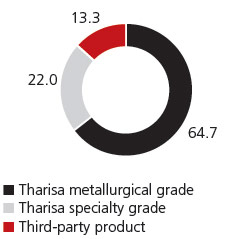
| Metallurgical grade | kt | 1 080.3 | 1 008.1 | |||
| Specialty grade | kt | 367.7 | 323.1 |
Tharisa Minerals' low-unit costs and multiple polymetallic products have ensured that it was well placed to manage commodity price volatility and exchange rates.
Its dual revenue streams provide a natural hedge against different commodity cycles with the products being used in different applications. PGMs are primarily used in the automotive, technology and jewellery industries while chrome is primarily used in the manufacture of stainless steel. These benefits, together with record production, has resulted in Tharisa Minerals surpassing production guidance in FY2018.
Safety
Tharisa acknowledges that the safety of its people is critical to its success. The LTIFR for FY2018 was 0.18 (2017: 0.07) per 200 000 man hours worked. Tharisa Minerals was awarded the Best in Class at MineSafe 2018, and in September 2018, Tharisa Minerals achieved 4 000 fatality-free production shifts.
Refer to the Safety and Health section of the sustainability report.
Mining operations
Tharisa Minerals holds a Mining Right over 5 475 ha of land near the town of Rustenburg in the North West province of South Africa. The Mining Right was granted on 19 September 2008 for an initial period of 30 years, providing access to a MG chromitite outcrop with a strike length of approximately 5 km.
The Tharisa Mine is currently a 15-year open pit operation with a projected 40-year underground life of mine extension. The mining operation, which is divided into the east pit and west pit, extracts reef from five MG Chromitite Layers.
Refer to the Mineral Resource and Mineral Reserve statement.
The change in operating model from contractor mining was implemented in FY2018. The change was the logical progression given the long life of the open pit, allowing Tharisa to take direct control over its mining operations, thereby controlling the reef grades and the delivery of improved quality ore to the processing plants, optimising the feed, throughput and recovery within the plants.
Tharisa's mining division mined 4.9 Mt of ROM for FY2018, a 3.0% decrease year on year. A total of 11.1 Mm3 of waste rock was mined for the year. While the stripping ratio of 7.9 on a m3:m3 basis remained below the LOM average of 9.5, it represented a 5.3% increase from the previous year. There was a reduction in year-on-year mining mainly due to availability of equipment. This was a result of an ongoing comprehensive maintenance plan to return the used mining fleet, purchased by Tharisa from the previous contractor, to OEM standards. The implementation of the necessary maintenance systems will see availability and utilisation increasing for FY2019, enabling the fleet to achieve the required mining rate of 5.2 Mtpa of ROM. A key focus of the mining division is improving the efficiencies of the drill and blast operations, which is essential to achieving the required stripping ratio. This will ensure ongoing access to the reef horizons and maintaining the supply of ore to the processing plants.
Processing
Tharisa Minerals' two independent processing plants are designed specifically to treat the MG Chromitite Layers of the Bushveld Complex. The smaller 1.2 Mtpa Genesis Plant, with the 100 ktpm chrome circuit, was commissioned in August 2011 with the PGM circuit being commissioned in December 2011. The larger 3.6 Mtpa Voyager Plant was commissioned in December 2012, both plants operate at above nameplate capacity and milled collectively 5.1 Mt. The plants have a similar process flow that includes crushing and grinding, primary removal of chrome concentrate by spirals, followed by PGM flotation from the chrome tails and a second spiral recovery of chrome from the PGM tails.
Operating in parallel, the independent plants provide processing flexibility and production stability by allowing one plant to be shut down without hampering the production of the other. The modular design of the processing circuits allows sections of the plant to be stopped without affecting the rest of the operation (i.e. a crushing circuit can be stopped independently of the communition, spiral and flotation circuits).
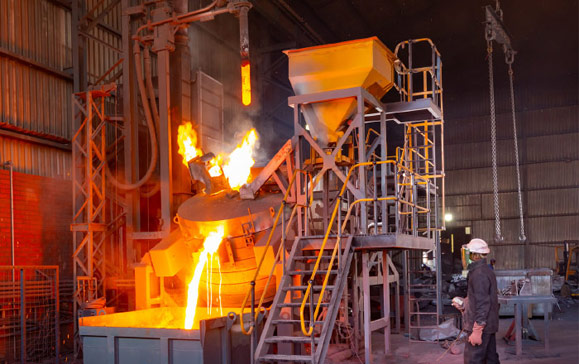
Using off the shelf technology, the processing circuits are uniquely engineered to deliver both PGM and chrome concentrates. This innovative approach to production has made Tharisa a world-class PGM and chrome co-producer.
The PGM rougher feed grade was marginally lower for the year at 1.51 g/t, while the Cr2O3 ROM feed grade improved by 2.3% to 18.2% for the year. A portion of the historically mined lower grade PGM stockpiles were utilised during the year to feed the processing plants, resulting in the lower PGM rougher feed grade. There is continued focus to increase the ROM stockpile during FY2019 with the appropriate blend of reef horizons.
Tharisa targets recoveries of 80.0% for PGMs and 65.0% for chrome. In FY2018 PGM recoveries improved to 84.1% from 79.7% in FY2017 while chrome recoveries were up at 66.0% from 64.1% the previous year.
During the year, the Group produced PGM concentrates containing 152.2 koz of contained PGMs (5PGE + Au) and chrome concentrates of 1.4 Mt, an improvement of 6.0% and 8.8% respectively from FY2017. Of the chrome concentrates produced, 367.7 kt was specialty grade concentrates.
Specialty chrome recovery circuits are integrated into the feed circuit of the Genesis Plant, known as the Challenger Plant. The Challenger Plant, which is owned by subsidiary Arxo Metals, was commissioned in July 2013 and produces chemical and foundry grade chrome concentrates.
Production of specialty grade concentrates, which accounted for 24.3% of total chrome production in FY2017, increased to 25.4% of total production in FY2018. Production of specialty grades will be maintained at current levels to ensure that it maintains a strategic market share.
Mining 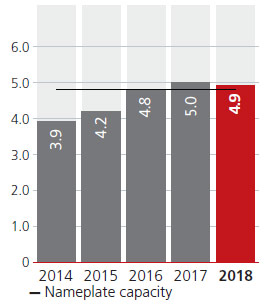 |
Plant feed  |
PGM production 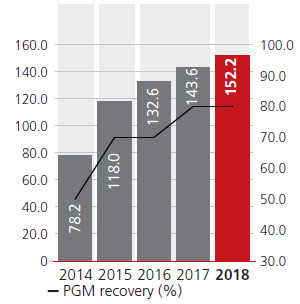 |
Chrome production 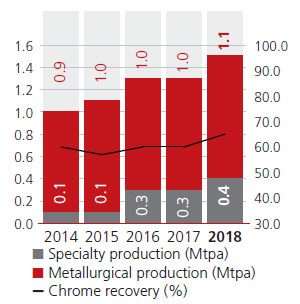 |
Tharisa Minerals' Vision 2020
The Vision 2020 projects are targeting an increase in Tharisa Minerals' production to 200 kozpa of PGMs and 2.0 Mt of chrome concentrates by the end of 2020. The FY2019 production guidance for the Tharisa Mine is 160 koz of PGMs and 1.5 Mt of chrome concentrates.
The optimisation projects and additional processing plants, together with improved mining grade, are planned to add 40 kozpa of PGMs and 500 ktpa of chrome concentrates to the Tharisa Mine's FY2019 annual production.
Upgrade of the crusher circuit at the Genesis Plant
The additional crusher circuit at the Genesis Plant was commissioned in Q1 FY2019. The US$7.5 million project aims to increase the Genesis Plant throughput by 15% or about 180 ktpa, targeting an increase in the higher value specialty grade chrome concentrates by adding approximately 24 ktpa of chemical grade chrome concentrate, approximately 18 ktpa of foundry grade chrome concentrate, and approximately 19 ktpa of metallurgical grade chrome concentrate.
PGM optimisation at the Voyager Plant
The addition of flotation capacity and the installation of high-energy mechanisms at the Voyager Plant is aimed at improving the PGM recoveries and increasing PGM production by an estimated 14 kozpa. The project is being implemented in a staged approach. The first phase of the project, the increase in high-grade flotation capacity, has been commissioned. The second phase of the project will be implemented in FY2019.
Vulcan Fine Chrome Recovery Plant
The construction of the Vulcan Plant will facilitate additional recovery of fine chrome from tailings streams. The proprietary process is being developed by Arxo Metals and a demonstration scale plant has been commissioned at Tharisa Minerals. The feasibility study based on the operation of the demonstration scale plant has been concluded. An engineering company has been awarded the plant FEED study.
Apollo PGM and Chrome Plant
A decision has been taken to suspend the development of the Apollo Plant. This is in light of additional testwork and studies that indicate the potential for an additional PGM recovery circuit following the Vulcan Plant, which would yield a better investment return.
Sales and marketing
The Group's market advantage is its exposure to both the PGM and chrome markets. This dual exposure gives the Group a hedge against volatility in either of the commodity prices.
Tharisa Minerals continues to supply the majority of its PGM concentrate to Impala Platinum in terms of its offtake agreement and is paid a variable percentage of the contained PGMs and base metals contained within each tonne of concentrate in terms of an agreed market formula.
The PGM basket price improved by 17.4% to US$923/oz in FY2018.
The PGMs in the MG ore mined by Tharisa Minerals occur in the silicates and are not associated with the chromite, thus enabling the process to extract chrome before PGMs without sacrificing PGM recovery.
This lowers the chrome content in the PGM circuit and results in much lower chrome content in the PGM concentrate compared to typical UG2 operations. Base metal content in the MGs is also significantly lower than Merensky and UG2 ores, resulting in a low matte fall during smelting, reducing base metal refining requirements.
Chrome concentrate sales totalled 1.6 Mt, 364.0 kt of which was Tharisa's higher value-add specialty chemical and foundry grade chrome concentrates. The bulk of the Tharisa sales are derived from metallurgical grade chrome concentrate. The sales included 216.6 kt of third-party chrome concentrates, resulting in a total increase of chrome concentrates sold by 24.8% from FY2017.
Specialty grade chrome concentrates produced by Tharisa are sold in terms of an agency and offtake agreement. The chemical grade chrome concentrate is jointly marketed with Tharisa and an independent third party.
Spot metallurgical chrome concentrate prices were volatile during the financial year fluctuating between US$156/t and US$240/t with the average price for metallurgical grade chrome concentrate on a CIF main ports China basis decreasing in US dollar terms to US$186/t from US$200/t for the previous year.
The production of the higher value specialty chrome concentrates, which typically command a premium of greater than US$50/t, provided a further buffer against fluctuations in the metallurgical grade chrome price.
Tharisa continued to deliver metallurgical grade chrome concentrate in terms of its five-year strategic cooperation agreement with Taiyuan Iron & Steel's ('Tisco's') joint venture company Shanxi Taigang Wanbang Furnace Charge Co. In terms of the agreement, which was effective as of September 2017, Tharisa Minerals will supply Tisco with a minimum of 240.0 ktpa of metallurgical grade chrome concentrate.
Metallurgical chrome production is shipped in bulk and containers via South African ports to major stainless steel and ferrochrome producers in China.
Products
The Tharisa Mine produces the following products:
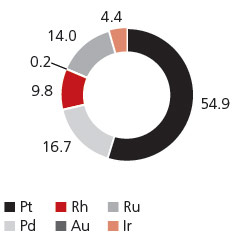
PGM concentrate: PGM concentrate is produced from both processing facilities. The concentrate produced from the Voyager Plant is a higher grade than the concentrate from the Genesis Plant due to the different chromitite reefs treated by the respective plants. The major component of the PGMs is platinum, followed by palladium and ruthenium.
| Average market price | FY2018 US$/oz |
FY2017 US$/oz |
Change % |
|||
|---|---|---|---|---|---|---|
| Platinum | 909 | 960 | (5.2) | |||
| Palladium | 996 | 798 | 24.9 | |||
| Rhodium | 1 957 | 927 | 111.2 | |||
| Ruthenium | 207 | 52 | 297.2 | |||
| Iridium | 1 156 | 820 | 40.9 |
Source: Johnson Matthey
Metallurgical grade chrome concentrate: The typical metallurgical grade produced by Tharisa is 40.0% to a 42.0% chrome (as Cr2O3) with the silica (SiO2) lower than 5.0%
Chemical grade chrome concentrate: The typical chemical grade produced by Tharisa is 44.0% to 46.0% Cr2O3 with the SiO2 lower than 1.0%. This is a higher value chromite product than the metallurgical grade chrome concentrate.
Foundry grade chrome concentrate: The typical foundry grade produced by Tharisa is 45.0% to 46.0% Cr2O3 with the SiO2 lower than 1.0%. The American Foundryman Society Grain Fineness Number (AFS Number) is managed between 45 and 50. As with the chemical grade chromite, this is a higher value chrome concentrate than the metallurgical grade chrome concentrate.
| Average chrome price | FY2018 US$/t |
FY2017 US$/oz |
Change % |
|||
|---|---|---|---|---|---|---|
| 42% metallurgical grade | 186 | 200 | (7.0) |
Prill split by mass for FY2018
(%)
Tharisa chrome production
split for FY2018
(%)
Arxo Metals
Arxo Metals owns the Challenger Plant, which is integrated into Tharisa Minerals' Genesis Plant. The Challenger Plant is dedicated to the production of specialty grade chrome concentrates, namely chemical and foundry grade concentrates. Specialty grade concentrates carry more stringent specifications and therefore fetch a higher selling price. Arxo Metals has an offtake agreement for the marketing and sales of its concentrates to customers in the chemical and foundry industries globally. Arxo Metals produced 81.9 kt of chemical grade chrome concentrate (2017: 65.7 kt) and 26.0 kt of foundry grade chrome concentrate (2017: 23.1 kt) in FY2018. The increased production was attributed to the consistent supply of the correct ore blend and optimisation of the feed circuit to maximise the amount of fines from the crushing plant that report to the Challenger Plant.
In August 2017, Arxo Metals entered into an agreement with Western Platinum, a subsidiary of Lonmin, on the operations of its K3 UG2 chrome plant and for the sales and marketing of the UG2 chrome concentrate produced. Arxo Metals unlocks greater value for Lonmin from the K3 UG2 chrome plant using innovative processing already in use at Tharisa's operations. The chrome production for FY2018 from the Lonmin K3 UG2 chrome plant was 221.8 kt, exceeding the target of 200.0 ktpa of chrome concentrates for the year by 10.9%.
Arxo Metals is also the beneficiation, research and development arm of the Group. Arxo Metals conducts extensive research into technologies and downstream beneficiation opportunities that have the potential to improve yields and recoveries at the Tharisa Mine. The creation of increased value PGM and chrome products through the expansion and optimisation of the Group's processing operations is its core focus.
Arxo Metals has commissioned a 1 MW DC furnace to produce PGM-rich alloys on a pilot scale. The furnace, operated by Tharisa Minerals, has produced its first PGM alloy, and is ramping up to full production.
The production of PGM rich alloys will further develop Tharisa's beneficiation capability and thereby the profitability of Tharisa's PGM segment.
Arxo Metals continues to evaluate low capital, low energy, value-adding beneficiation projects through in-house research and development.
Research and development
The development of innovative approaches to conventional mineral processing and of new technologies is what has allowed Tharisa to establish itself as a low-cost producer of strategic commodities.
There are three streams in terms of the R&D works that are being undertaken by the Group, these are:
- Development of our beneficiation capabilities
- Development of niche products from our mineral products
- Development of new markets and uses
Arxo Resources
Arxo Resources has the exclusive right to sell the metallurgical grade chrome concentrate produced by Tharisa Minerals to customers in China and other international markets. It has established a strong platform with global customers in China including stainless steel and ferrochrome producers as well as global commodity traders.
Arxo Resources has a marketing agreement with Noble, a global commodities trading company listed on the Singapore Stock Exchange, whereby Noble acts as an agent for the marketing of 600.0 ktpa of metallurgical grade chrome concentrate produced by Tharisa Minerals.
Arxo Resources also has a joint marketing agreement for Tharisa Minerals' chemical grade chrome concentrate production.
In FY2018, Arxo Resources sold 1.3 Mt (2017: 995.8 kt) metallurgical grade chrome concentrates, of which 1.1 Mt was Tharisa Minerals'.
The scale of Arxo Resources operations allows for direct access to market and price discovery. Its established contacts with customers also directly creates an excellent platform for additional sales of third-party products.
Arxo Logistics
Arxo Logistics provides an integrated logistics platform that reduces the risk and costs of transporting concentrates. It manages the road transportation of Tharisa's PGM concentrates to Impala Platinum and the long haul transportation of chrome concentrates from the Tharisa Mine and Lonmin's K3 UG2 chrome plant to international customers through bulk and container vessels. Exports take place via the Richards Bay Dry Bulk Terminal and the Durban container port on the South African coast.
Arxo Logistics has a good relationship with both South Africa's transport parastatals, Transnet and the port authorities. Arxo Logistics currently has the exclusive use of the Marikana railway siding for chrome exports.
Arxo Logistics shipped a total of 1.3 Mt (2017: 995.8 kt) of chrome concentrate in FY2018 mostly to main ports in China, including third-party materials. Of this, 99.6% was shipped in bulk with bulk shipments being preferred by customers due to ease of handling and reduced port charges, as well as reduced levels of administration.
The logistics arm of the Group has the necessary road and rail transport capacity, warehousing facilities and port facilities at the Richards Bay Dry Bulk Terminal and the Durban container port to manage Tharisa Minerals' full production capacity. It also serves as a platform from which the Group can provide services to additional third-party customers.
Arxo Logistics provided third-party logistics services during the year under review and is planning to expand this service offering in the year ahead.
Exploration projects
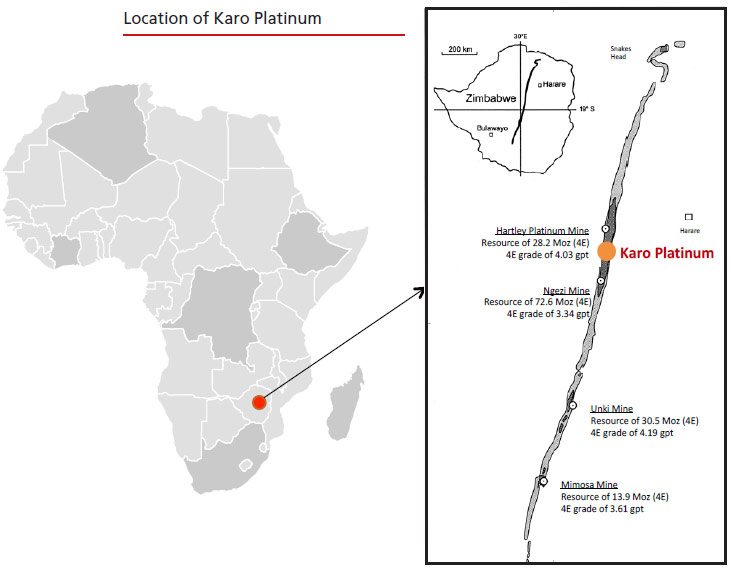
The Great Dyke in Zimbabwe is a geological feature of great significance as it hosts the world's second largest deposits of PGMs and chrome, outside of South Africa's Bushveld Complex. The Great Dyke is over 550 km long and up to 11 km wide. There are two mineralised horizons, namely the main sulphide zone ('MSZ') and the lower sulphide zone ('LSZ'). Current mining operations located on the Great Dyke exploit the MSZ, while the LSZ is largely under explored.
Karo Holdings
In June 2018, Tharisa acquired a 26.8% shareholding in Karo Holdings. Karo Holdings entered into an investment agreement with the Republic of Zimbabwe on 22 March 2018 in terms of which Karo Holdings has undertaken to establish an integrated PGM mining complex. The project will include PGM mines, concentrators, smelters, a base metal and precious metals refinery, as well as power generation capacity for the operations with surplus energy capacity made available to the Zimbabwe power grid.
Karo Platinum, an indirect 50% held subsidiary of Karo Holdings applied for and was awarded PGM rights under a Special Grant under the Zimbabwe Mines and Minerals Act, covering an area of 23 903 ha. The licence area is situated on the Great Dyke in the Mashonaland West District of Zimbabwe. This area of land had been released by Zimbabwe Platinum Mines (Private) Limited from its mining lease area in support of the government of Zimbabwe's efforts to enable participation by other investors in the platinum mining industry in Zimbabwe. In terms of the Special Grant, Karo Platinum will be entitled to mine PGMs situated within the licence area. Karo Platinum will be responsible for the mine development and mining operations, which will deliver run of mine ore to Karo Refining. Karo Refining, 75% owned by Karo Holdings, will build, own and operate the concentrators and smelters, as well as the base metal and PGM refinery.
Karo Holdings, through its 75% held subsidiaries, Karo Coal and Karo Power respectively agreed to identify and establish a coal project with a focus on metallurgical coal and a power generation project. The project will include the phased development of a renewable energy source of 300 MW of solar power, to be fed into the national grid. Technical and financial partners have been identified for this project.
Salene Chrome
Tharisa was granted a call option to acquire a 90% shareholding in Salene Chrome, exercisable on completion of the exploration programme. Salene Chrome was awarded three Special Grants covering an area of approximately 9 500 ha on the eastern side of the Great Dyke in Zimbabwe. The Special Grants entitle Salene Chrome to mine the minerals thereon including illuvial chrome, being at surface chrome fines generated from seams as a result of weathering. In addition, Salene Chrome has been awarded three Prospecting Special Grants on the western side of the Great Dyke to undertake prospecting activities for all commodities including PGMs, gold and base metals. The western area is approximately 12 000 ha.
 |
|
| Source: https://www.researchgate.net/figure/Generalized-geology-of-the-Great-Dyke-and-locations-ofplatinum- mines-and-prospects fig1 235917128 and Company Data |