
Market
review
South Africa is home to the world's largest PGM and chrome deposits; and its mining industry is therefore an essential component of the global commodity supply chain.
US dollar PGM basket prices improved during the year, backed by the rally in rhodium and ruthenium prices, despite the decline in the platinum price. 42% metallurgical grade chrome concentrate prices fluctuated during the year, reaching a high of US$240/t and closed at US$160/t.
Tharisa's co-producer business model allows the Group to benefit from higher pricing environments and conversely absorb the effects from price shocks.
Tharisa's market position
Tharisa is the only JSE and LSE listed co-producer of PGM and chrome concentrates. Chrome continues to play a significant role in South Africa's economy, with the country producing 16.6 Mt (54.7% of global supply), with exports generating more than ZAR12.6 billion in revenue for the national current account. PGM exports account for ZAR85.1 billion for the current account.
Tharisa is the fourth largest primary producer of chrome concentrates and the seventh largest producer of PGMs in South Africa, accounting for 8.7% of South African chrome production.
Tharisa remains one of the world's largest producers of specialty grade chrome concentrates.
PGM market
PGMs are vital industrial metals valued for their durability, resistance to corrosion and catalytic properties. The automotive industry is the world's largest consumer of PGMs, which are used in catalytic converters for vehicle exhaust systems. Other drivers of demand are jewellery, industrial uses and investment.
With its rich mineral wealth, South Africa is home to the world's largest PGM deposits and remains the world's principal producer, estimated to be responsible for 70.0% of the total refined platinum production in 2018.
According to the WPIC Q2 2018 report, South African refined platinum production is forecast to reduce by 1.1% from 2017, producing 4.3 Moz. Tharisa's prill split contains a higher content of rhodium and ruthenium than other Bushveld Complex concentrates. An increase in demand is likely to be seen in palladium and ruthenium. Further advances in the deployment of fuel cell technology in vehicles are likely to see a rise in platinum demand.
PGM end uses
 |
Platinum
|
 |
Ruthenium
|
|||
 |
Palladium
|
 |
Iridium
|
|||
 |
Rhodium
|
 |
Gold
|
PGM prices in FY2018
Johnson Matthey's monthly averages for platinum show that the metal ended FY2018 at US$810.3, a decrease of 12.7% over the period, while palladium increased 5.8% to US$1 017.0. Rhodium continued its rally during FY2018 by increasing a further 77.4% to US$2 465.3. However, the best performing metal was ruthenium, recording a price of US$261.8 at the period end, a 220.9% increase. Tharisa's basket price for FY2018 increased by 17.4% in US dollar terms and by 14.7% in ZAR terms.
| FY2018 | FY2017 | Change% | ||||||
|---|---|---|---|---|---|---|---|---|
| PGM basket price | US$/oz | 923 | 786 | 17.4 | ||||
| PGM basket price | ZAR/oz | 12 038 | 10 492 | 14.7 |
PGM
(US$/oz)

Chinese imports of chrome
2017 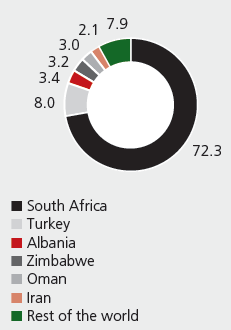 |
Chrome market
South Africa hosts the largest chromite reserves in the world, accounting for approximately 72.0% of the world's chrome. In 2017, South Africa produced 16.6 Mt of chrome concentrates, equating to 54.7% of global production for the year. The annual South African production increased by 4.8% from 2016. The ICDA reports that South Africa produced 9.9 Mt of chrome concentrates in the first six months of 2018.
South Africa exported over 10.8 Mt of chrome ores in 2017, an increase of 27.6% from 2016. The balance of South Africa's production is sold locally as feedstock for the ferrochrome industry. Of South Africa's exports, 93.0% of these were destined for China. China is reliant on imports of chrome ores and concentrates to supply its ferrochrome and stainless steel manufacturing industries. Therefore, there is a high correlation between stainless steel production and ferrochrome demand, and between ferrochrome demand and the demand for chrome ores and concentrates.
Chrome end uses
Chrome ore demand is driven by ferrochrome use, with more than 90.0% of chrome ore being used for metallurgical purposes. Approximately 5.0% of demand is derived from chemical industry and the balance from the foundry and refractory industries. The majority of metallurgical grade chrome concentrate is utilised in the production of ferrochrome. In turn, the largest consumer of ferrochrome is stainless steel. As such, the dynamics from the stainless steel industry have an impact on both the ferrochrome and chrome ore industries. In 2017, global stainless steel production increased by 5.0% year on year according to the International Stainless Steel Forum, in turn driving demand for ferrochrome and chrome ores.
 |
Metallurgical grade
|
 |
Foundry grade
|
|||
 |
Chemical grade
|
 |
Refractory grade
|
Global production
(Mt)

To produce one tonne of stainless steel
| CHROME ORE |  |
FERROCHROME | |
STAINLESS STEEL |
| 0.6 tonnes | 0.25 tonne | 1 tonne |
Chrome prices in FY2018
Prices for metallurgical grade chrome concentrate ranged from US$156/t to highs of US$240/t for the year under review. Chrome concentrate port stocks in China reached an all-time high during the financial year of 3.8 Mt at the end of August 2018. Domestic Chinese consumption equates to approximately 1.2 Mt per month, resulting in a supply of 12 weeks at the peak, assuming that all stocks were immediately available. This increase in inventory holding increased the volatility in pricing seen in the market. Subsequently, stocks at port have reduced to below 3.0 Mt.
The average metallurgical grade chrome contract price achieved was US$186/t CIF China for FY2018.