
Safety and
Health
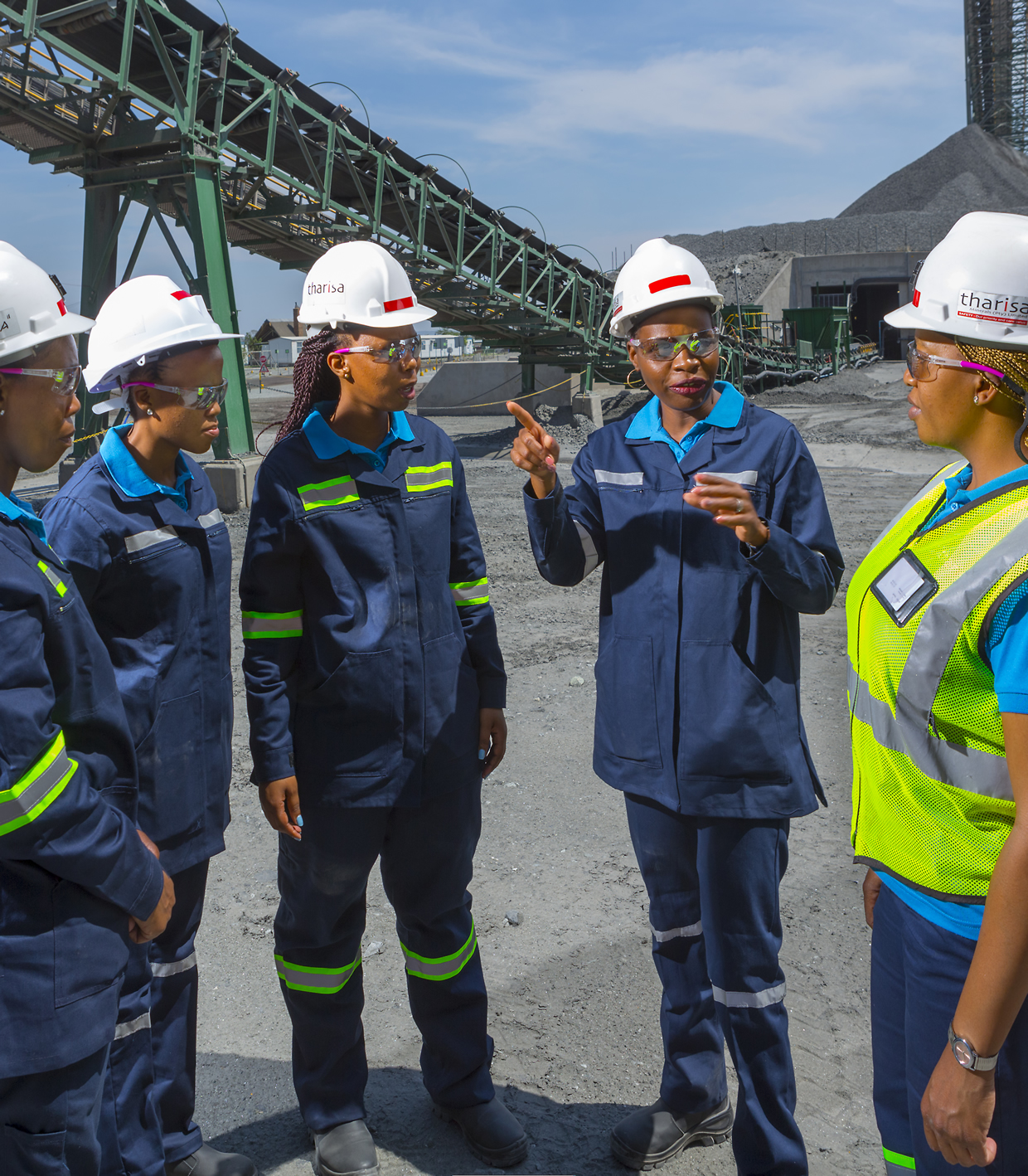
Tharisa's business is reliant on a healthy, skilled, competent and committed workforce. The safety of the Group's people is of the utmost importance to Tharisa and takes precedence over all production objectives. Tharisa aims to explore, mine, process, market and distribute its products to customers without harming anyone.
Tharisa Minerals' safety performance compares well against those of its industry peers. In recognition of these achievements, Tharisa Minerals was awarded the Best in Class Safety award at MineSafe 2018. The Mine Health and Safety Committee ('MHSC') also presented Tharisa Minerals an award for 4 000 fatality-free production shifts at its process plant operations.
Tharisa is pleased to report that there were no fatalities during FY2016, FY2017 and FY2018. While open cast operations are considered safer than underground mining operations, Tharisa Minerals has taken extra care to ensure its processes and policies are adhered to and that employees are kept well informed of potential safety hazards through continual training. Focus continues to be placed on supervisory training and holding supervisors accountable for their actions. The quality of incident investigations is of utmost importance, ensuring that corrective and preventive actions focus on eliminating, redesigning and separating risks in line with the hierarchy of controls.
The Safety, Health and Environment committees at both the holding company and operating subsidiary levels are responsible for overseeing compliance with health and safety legislation and policies. All mining and processing employees, including contractors, receive safety training. Where injuries have occurred, Tharisa Minerals' focus has been on completing effective investigations and root cause analysis to prevent repeat incidents from occurring.
At 30 September 2018, Tharisa Minerals achieved 20 401 196 fatality-free hours and 2 317 749 fatality-free shifts.
The Group employs a Safety Management System. The system requires a baseline risk assessment to identify the major risks at the operations. These risks are then examined further by conducting issue-based risk assessments and identifying appropriate control measures to mitigate the risks. Measures can include standards and procedures updates, as well as training lesson plans. To ensure compliance, a system of "over-inspection" by supervisors and safety staff is implemented. Further mitigation measures include visible felt leadership and ongoing training.
As required by South African regulations, Tharisa Minerals has established a mine Safety and Health Committee that approves and implements all mandatory safety training. Safety staff oversee inspections of work performance, site conditions and identify and allocate any necessary corrective actions.
Tharisa is committed to the health of its employees and has implemented a number of programmes to facilitate wellbeing among those who work for the Group. Chief among these programmes is the Tharisa Minerals' occupational health programme, which has as its key focus tuberculosis ('TB'), HIV/AIDS, dust exposure and noise-induced hearing loss. TB and HIV/AIDS are being addressed via a strong focus on prevention through education and awareness initiatives. Antiretroviral treatment ('ART') is offered to eligible persons and the programme is managed through our wellness service provider.
The HIV prevalence rate among Tharisa Minerals' own employees is 12%. The prevalence rate including contractors is 10%. This information is derived from medical examinations which all employees undertake (initial, periodical and exit medicals) at which employees, including contractors, are encouraged to undergo voluntary counselling and testing ('VCT'). In addition, Tharisa Minerals employees attend a Wellness Day and a World HIV/AIDS day at which VCT engagements are undertaken. Through this process every employee that tests positive is provided counselling and is encouraged to participate in the ART programme.
The Tharisa Minerals Thusanang Wellness Programme has been running since December 2011 with the aid of Calibre Clinical Consultants ('Calibre'). "Thusanang" is a Setswana word meaning "helping each other". The programme was designed to provide support, counselling and training to employees, their families, and the community about their lifestyle, wellbeing and work environments. Campaigns have included cancer awareness presentations and World AIDS Day HIV awareness education and counselling.
The Tharisa Minerals' Peer Educator Programme was launched in September 2012. The course trains a group of employees who champion the programme and provide further wellness education to employees and the community. Tharisa Minerals has 28 peer educators. In 2018, the peer educators underwent refresher training.
The Tharisa Mine has also implemented random testing for drugs and compulsory testing for alcohol in a bid to ensure the safety of all of its employees. Employees who test positive are not permitted on site and are subject to disciplinary procedures. They are also offered counselling and/or rehabilitation.
Hearing
The MHSC 2025 Health and Safety Milestones stipulate that no employee's standard threshold shift ('STS') should exceed 25 dB from the baseline when averaged over 2 000, 3 000 and 4 000 Hz in one or both ears by December 2016. This milestone is monitored during annual medical examinations. High-noise zones have been identified and Tharisa Minerals ensures that personnel working in these high-risk areas are issued with personalised hearing protection. These high-noise zones are assessed and updated annually. The issuing of personalised hearing protection has been extended to the medium risk areas.
The MHSC has also set a December 2024 target where the total operational or process noise emitted by any equipment must be below 107 dB (A). Tharisa Minerals has achieved this target. Engineering staff continue to ensure that all new equipment meets this requirement.
Tuberculosis ('TB')
Tharisa Minerals actively campaigns to increase awareness of TB and its symptoms. These campaigns encourage all employees, including contractors, to participate in screening.
The MHSC's 2025 milestones aims to reduce the rate of TB among mineworkers to the national incident rate or below.
Tharisa Minerals' interventions to address and reduce TB among its workforce include increased TB screening, TB awareness campaigns, questionnaires to identify symptoms and the enlisting of trade union involvement in and commitment to improving TB awareness and lowering incident rates among employees and their families.
TB screening is done on an ad hoc basis and during the occupational medical examinations. Sputum tests are conducted on employees who are potentially at risk of having TB.
Isolated cases of TB have been detected, however, the outcomes of the investigations have indicated that they were non-work-related cases. The individuals were treated and have all returned to their working environments.
All cases of TB have been reported to the Medical Bureau of Occupational Diseases, Compensation for Occupational Injuries and Diseases and the DMR as per the legislated requirements.
HIV
As legislated, HIV screening is voluntary. Tharisa Minerals actively campaigns to increase awareness of HIV, its cause, its symptoms and treatment. All employees, including contractors, are encouraged to participate in the screening.
All of the Tharisa Mine's employees are offered Haematocrit blood tests annually and all eligible employees are counselled and asked if they would like to join an ART programme, which is run and managed by a third-party service provider, Calibre. Tharisa Minerals, the Occupational Medical Practitioner and Calibre work together to increase the uptake of ART. These interventions include pre- and post-test counselling, awareness programmes, roadshows and are a focus of the Peer Educator Programme. HIV statistics are based on HIV testing done during medical examinations.
Furthermore, Tharisa Minerals has a Community Peer Educator who conducts home visits in the community and health campaigns are being conducted in the community by the service provider. The main objective is to help prevent HIV in our community as well as make an impact against the stigma attached to HIV. This is done through community outreach and the distribution of HIV and TB information as well as information on where to seek assistance. The Tharisa Mine also distributes condoms in the community shops and taverns.
Silicosis
In compliance with the MHSC 2025 Health and Safety Milestones, levels of respirable crystalline silica have to be reduced in 95% of all individuals (not averages) to below OEL of 0.05 mg/m3 by December 2024. Tharisa Minerals is using quality dust masks and compliance is monitored during visible field leadership and inspections. Tharisa Minerals complies with the 95% milestone as stipulated.
Wellness campaigns
A TB campaign awareness presentation was held in April 2018, where employees were encouraged to participate in an education programme. Other campaigns and interventions successfully held in the year under review include:
- cervical and prostate cancer screening – November 2017
- STI awareness presentation – February 2018
- community STI awareness – February 2018
- community health screening – March 2018
- community TB campaign – April 2018
- fun run and walk – April 2018
- Wellness Days – September 2018.