
Leadership
review
Loucas Pouroulis
Executive Chairman
Phoevos Pouroulis
Chief Executive Officer
Michael Jones
Chief Finance Officer
Dear Stakeholder
In compiling this report, we have been guided by materiality so that we report concisely on those issues most material to our stakeholders and our ongoing ability to create value. More detailed information is available on our website, www.tharisa.com.
FY2018 was a year of record production achieved with increased plant throughput and metal recovery. The prill split of the PGM concentrate, which favours palladium and rhodium, contributed to an overall increase in the PGM basket price despite the lacklustre pricing seen in platinum. Metallurgical chrome concentrate prices were muted. Against the backdrop of increased production volumes and prevailing commodity markets and notwithstanding material increases in both fuel prices and freight rates, we still generated strong cash flows from operations. Our mining operations took a major step forward, as we became owner operator of our mining fleet in the year under review. We also continued to effectively leverage the business model with third-party agency and trading activities. Our commitment to innovation is visible in the improvements we delivered in processing, and we added further value via our extensive research and development activities. We believe these strategic advances will lead to further improvements in production and provide a strong base for the Company to continue its growth.
Tharisa Minerals recorded production of 152.2 koz of contained PGMs and production of 1.4 Mt of chrome concentrates for the financial year. Of the chrome concentrates, 367.7 kt comprised higher value specialty grade products.
Tharisa is now firmly established as a trusted supplier of quality metallurgical chrome, specialty chrome and PGM concentrates. This allowed us to begin the implementation of our diversification strategy, and we have secured early mover optionality in two exploration projects on the mineral rich Great Dyke of Zimbabwe.
Our approach to growth has always been measured and deliberate. We believe this discipline has been central to the success of the Tharisa story, which has led us to become a low cost, highly integrated and innovative co-producer of PGMs and chrome.
During the year under review, the PGM basket price increased by US$137/oz on the back of the rally in the rhodium, ruthenium, and iridium prices underpinned by strong palladium prices to average at US$923/oz. Palladium, continued to trade at a premium to platinum on the back of growing deficit forecasts. The platinum price, however, remained subdued, trading at 10-year lows. Following the previous year where metallurgical chrome concentrates prices reached unprecedented highs of approximately US$390/t, FY2018 saw chrome concentrate prices fall below US$200/t. This was mainly due to increasing stock levels of chrome ores in Chinese main ports peaking at 3.8 Mt. The average metallurgical chrome contract price achieved was US$186/t CIF China for FY2018.
Operating profit for the year amounted to US$72.5 million (2017: US$98.4 million), with a net profit after tax of US$51.0 million (2017: US$67.7 million) generating HEPS of US$ 19 cents (2017: US$ 22 cents). Importantly the Group generated net cash from operations of US$89.8 million (2017: US$75.7 million) and after taking into account the capex a free cash flow of US$49.3 million (2017: US$53.1 million).
It is the Group's policy to pay a minimum of 15% of its consolidated net profit after tax as a dividend. This year the Group paid its maiden interim dividend of US$ 2 cents per share. The directors are pleased to announce that based on solid earnings and subject to the necessary shareholder approval, the Board has proposed a final dividend to shareholders of US$ 2 cents per share, totalling US$ 4 cents per share for FY2018 (2017: US$5 cents), equating to 20.5% of its consolidated net profit after tax.
The dividend pay out takes into consideration various factors, including overall market and economic conditions, the Group's financial position, capital investment plans as well as earnings growth.
Safety
Safety is a core value and Tharisa continues to strive for zero harm at its operations. Tharisa achieved an LTIFR of 0.18 per 200 000 man hours worked at 30 September 2018 and was fatality free for the third year in succession. Tharisa continues to implement appropriate risk management processes, strategies, systems and training to promote a safe working environment for all.
In line with the Department of Mineral Resources' ('DMR') drive to minimise all injuries within the South African mining industry, the Group is committed to ensuring a safer workplace. To that end, it is pleasing to report that Tharisa Minerals was awarded a Best in Class safety award at MineSafe 2018 and in September 2018 the Tharisa operations achieved 4 000 fatality-free production shifts.
South Africa
South Africa's DMR, under the leadership of Honourable Minister Gwede Mantashe, issued a new Mining Charter in October 2018, aimed at promoting much needed investment in the resources sector by ensuring greater investor certainty. While Tharisa came into existence after new mining regulations were promulgated in 2004, we nevertheless welcome the new Mining Charter, as it sets guidelines and structures for future investments. Given our further 15-year open pit life with a potential further 40-year underground life at the Tharisa Mine, we are comfortable that this Mining Charter will bring the necessary certainty we, as long-term investors, require.
Tharisa joined South Africa's Minerals Council this year, an industry body aimed at promoting dialogue between the mining industry and government. We have joined the Platinum Leadership Forum, focusing on supporting and growing demand for the platinum industry, and also proposed the formation of the Chrome Leadership Forum within the Minerals Council structures. Chrome continues to play a significant role in South Africa's economy, with the country producing 16.6 Mt or 54.7% of global supply, with exports generating more than ZAR12.6 billion in revenue for the national current account. Tharisa is the fourth largest primary producer of chrome in South Africa and accounts for 8.7% of South African chrome production. PGM exports account for ZAR85.1 billion for the current account and Tharisa is the seventh largest producer of PGMs in South Africa.
Operational overview
A number of milestones were achieved during the financial year including:
- 5.1 Mt ROM milled, an increase of 3.9%
- 84.1% overall PGM recovery, an increase of 5.5%
- 152.5 koz 5PGE + Au contained PGM production, up by 6.0%
- 66.0% chrome recovery, an increase of 3.0%
- 1.4 Mt production of chrome concentrates from the Tharisa operations, up by 8.8%
- 367.7 kt specialty grade chrome production, an increase of 13.8%
- exceeded targeted production at Lonmin K3 chrome plant by 10.9% at 221.8 kt
- 1.6 Mt of chrome concentrates sold, an increase of 24.8%
Mining
Tharisa's mining division mined 4.9 Mt of ROM for FY2018, a 3.0% decrease year on year. A total of 11.1 Mm3 of waste was moved for the year. While the stripping ratio of 7.9 on a m3:m3 basis remained below the LOM average of 9.5, it represented a 5.3% increase from the previous year. There was a reduction in year-on-year mining, mainly due to availability of equipment. This was as a result of an ongoing comprehensive maintenance plan to return the used mining fleet, purchased by Tharisa from the previous contractor, to OEM standards. The implementation of the necessary maintenance systems will see availability and utilisation increasing for FY2019, enabling the fleet to achieve the required mining rate of 5.2 Mtpa. A key focus of the mining division is improving the efficiencies of the drill and blast operations, which is essential to achieving the required stripping ratio. This will ensure ongoing access to the reef horizons and maintaining the supply of ore to the processing plants. The introduction and implementation of systems and connectivity across the mining fleet coupled with state-of-the art simulator operator training are key focus areas for the Tharisa mining division to achieve the same levels of integration and efficiency as has been achieved in the processing division. The mining operations are transitioning to a 24-hour four shift, operation thereby increasing mining capacity by approximately 15%.
Processing
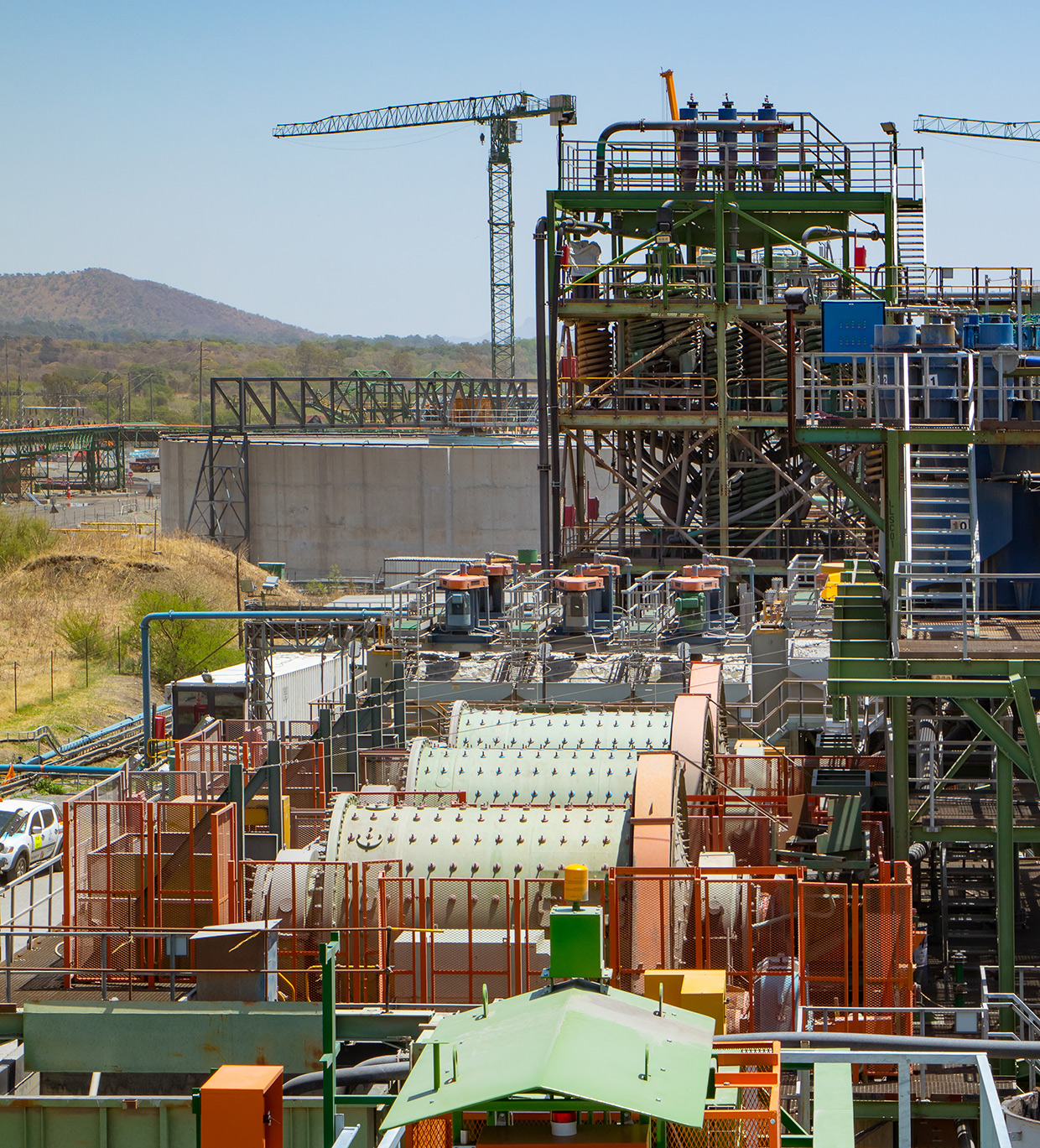
Plant throughput for FY2018 at 5.1 Mt exceeded the nameplate capacity. This is attributable to consistent feed and preventative maintenance resulting in improved plant availability and utilisation. The further optimisation of the high energy PGM flotation circuit at the Genesis Plant further increased recoveries.
With a PGM rougher feed grade of 1.51 g/t and recoveries improving to 84.1% (against a target of 80%), PGM production (5PGE + Au) was 152.2 koz, an improvement of 6.0%. Chrome feed grade was 18.2% and with chrome recoveries improving to 66.0% (target 65%), chrome concentrate production increased by 8.8% to 1.4 Mt. The production of specialty grade chrome concentrates of 367.7 kt increased 13.8% and constitutes approximately 25.4% of total chrome concentrate production. Specialty grade chrome concentrates continue to command on average a US$50/t premium on a CIF China equivalent basis over standard metallurgical grade chrome concentrates.
Arxo Metals surpassed its chrome concentrate production target at the Lonmin K3 chrome plant by 10.9%, to produce 221.8 kt of chrome concentrates mainly through applying the operational skills and standards deployed at the Tharisa processing division. Further upgrades are proposed for the K3 plant in FY2019 which, if implemented, will see further improvements in chrome production.
Vision 2020
The Vision 2020 projects are targeting an increase in Tharisa Minerals' production to 200 kozpa of PGMs and 2.0 Mt of chrome concentrates by the end of 2020 on an annualised basis.
The optimisation projects and additional processing plants, together with improved mining grade, are planned to add 40 kozpa of PGMs and 500 ktpa of chrome concentrates to the Tharisa Mine's annual production guidance for FY2019 of 160 kozpa of PGMs and 1.5 Mt of chrome concentrates.
Upgrade of the crusher circuit at the Genesis Plant
The additional crusher circuit at the Genesis Plant was commissioned in Q1 FY2019. The US$7.5 million project aims to increase the Genesis Plant throughput by 15% or about 180 ktpa, targeting an increase in the higher value specialty grade chrome concentrates by adding approximately 24 ktpa of chemical grade chrome concentrate, approximately 18 ktpa of foundry grade chrome concentrate and approximately 19 ktpa of metallurgical grade chrome concentrate.
PGM optimisation at the Voyager Plant
The addition of flotation capacity and the installation of high-energy mechanisms at the Voyager Plant is aimed at improving PGM recoveries and increasing PGM production by an estimated 14 kozpa. The project is being implemented in a staged approach. The first phase of the project, the increase in high-grade flotation capacity, has been commissioned. The second phase of the project will be implemented in FY2019.
Vulcan Fine Chrome Recovery Plant
The construction of the Vulcan Plant will facilitate additional recovery of fine chrome from tailings streams. This proprietary process has been developed by Arxo Metals and a demonstration scale plant has been commissioned at Tharisa Minerals and through systematic operation has proven the concept and process flow. The feasibility study based on the operation of the demonstration scale plant has been concluded. An engineering company has been awarded the FEED study.
Apollo PGM and Chrome Plant
A decision has been taken to suspend the Apollo Plant project. This is in light of the additional testwork and studies that indicate the potential for an additional PGM recovery circuit following the Vulcan Plant, which would yield a better investment return.
Exploration projects
Our exploration focus is on the Great Dyke in Zimbabwe, which, just like our existing operations in the Bushveld Complex in South Africa, represents a unique, resource rich geological formation. We believe that being an early mover in this territory positions us strategically to benefit from current reforms that are transforming the mining sector in Zimbabwe. Our approach in developing these exciting projects will be gradual, staged and measured, with the necessary protections and approvals in place before we commit capital.
Karo Mining Holdings
In June 2018, Tharisa acquired a 26.8% shareholding in Karo Mining Holdings at a low-cost entry point of US$4.5 million. Karo Mining Holdings has been awarded a Special Grant over an area covering 23 903 ha on the Great Dyke of Zimbabwe. In terms of the Investment Project Framework Agreement with the Government of Zimbabwe, the plan is to establish a vertically integrated PGM mining complex. Based on historic testwork, this area is purported to contain some 96 Moz of PGMs at an average grade of 3.2 g/t (3PGE + Au).
Salene Chrome Zimbabwe
Tharisa was granted a call option to acquire a 90% shareholding in Salene Chrome Zimbabwe, exercisable on completion of the exploration programme. Salene Chrome Zimbabwe was awarded three Special Grants covering an area of approximately 9 500 ha on the eastern side of the Great Dyke in Zimbabwe. The Special Grants entitle Salene Chrome Zimbabwe to mine the minerals thereon, including illuvial chrome, which are at surface chrome fines generated from seams as a result of weathering. Salene Chrome Zimbabwe has also been awarded three additional prospecting Special Grants on the western side of the Great Dyke, over an area of approximately 12 000 ha.
Research and development
Our approach to research and development is founded in our core value of innovation. We strive to push through established boundaries and limitations within existing processing and product development, optimising processes and challenging convention. The successful commissioning and operation of our PGM DC smelter is a case in point. We have successfully produced 12 t of smelter matte and are in the process of commissioning our PGM converter to upgrade the matte to an alloy with a 6 to 10-fold upgrade in the PGM concentration per tonne. The development of this downstream beneficiation of our PGMs is part of our philosophy of capturing value and margin down the supply chain and ultimately being in control of metal flows through direct sales. On fulfilment of the current Tharisa Mineral's PGM offtake obligation, the intention would be to construct a larger smelter and refining complex to refine our PGMs to final concentrate or refined metal, subject to final viability.
The proprietary Vulcan process was developed in-house and has proven to be economically viable in the recovery of fine chrome particles that traditionally have not been recoverable within the chrome industry. FY2019 will see the commencement of the construction of the full scale 500 tph Vulcan Plant with an estimated completion in Q2 2020.
Commodity markets and sales
| 30 September 2018 | 30 September 2017 | Change % | |||||||
|---|---|---|---|---|---|---|---|---|---|
| PGM basket price | US$/oz | 923 | 786 | 17.4 | |||||
| PGM basket price | ZAR/oz | 12 038 | 10 492 | 14.7 | |||||
| 42% metallurgical grade chrome concentrate contract price | US$/t | 186 | 200 | (7.0) | |||||
| 42% metallurgical grade chrome concentrate contract price | ZAR/t | 2 415 | 2 667 | (9.4) | |||||
| Exchange rate | ZAR:US$ | 13.1 | 13.4 | (2.2) |
Tharisa Minerals continues to supply the majority of its PGM concentrate to Impala Platinum in terms of its offtake agreement, with the balance of the PGM concentrate processed in the 1MW research and development furnace that was recently commissioned and/or sold to Lonmin.
A total of 152.2 koz of contained PGMs (on a 5PGE + Au basis) was sold during the year. This is an increase of 6.1% over the previous year's sales of 143.5 koz of contained PGMs (on a 5PGE + Au basis).
The PGM prill split by mass is as follows:
| 30 September 2018% | 30 September 2017% | ||||
|---|---|---|---|---|---|
| Platinum | 54.9 | 55.2 | |||
| Palladium | 16.7 | 16.1 | |||
| Rhodium | 9.8 | 9.5 | |||
| Gold | 0.2 | 0.2 | |||
| Ruthenium | 14.0 | 14.3 | |||
| Iridium | 4.4 | 4.7 |
Tharisa Minerals is paid a variable percentage of the market value of the contained PGMs in terms of an agreed formula. The PGM basket price improved, with the average PGM basket price per ounce increasing by 17.4% to US$923/oz (2017: US$786/oz) for the financial year.
Tharisa's own chrome concentrate sales totalled 1.4 Mt, 371.9 kt of which was higher value-add specialty chemical and foundry grade chrome concentrates with the bulk of the sales being metallurgical grade chrome concentrate. The average price for metallurgical grade chrome concentrate on a CIF main ports China basis decreased to US$186/t (2017: US$200/t).
Third-party sales amounted to 216.6 kt for the year, resulting in Tharisa marketing and selling a total of 1.6 Mt of chrome concentrate products during the year.
Logistics
| 30 September 2018 | 30 September 2017 | Change % | |||||||
|---|---|---|---|---|---|---|---|---|---|
| Average transport cost per tonne of chrome concentrate – CIF China basis | US$/t | 62 | 52 | 19.2 | |||||
| Chrome concentrates shipped (including third-party materials) | kt | 1 247.8 | 995.8 | 25.3 |
The chrome concentrates destined for main ports in China were shipped either in bulk from the Richards Bay Dry Bulk Terminal or via containers and transported from Johannesburg by road to Durban for shipment. The economies of scale and in-house expertise have ensured that our transport costs, a major cost of the Group, remain competitive.
Arxo Logistics has sufficient storage capacity at both the Richards Bay Dry Bulk Terminal and the Durban container port to manage Tharisa Minerals' full production capacity.
A total of 1.3 Mt (2017: 995.8 kt) of chrome concentrates was shipped by Arxo Logistics in FY2018, mostly to main ports in China. Of this, 99.6% was shipped in bulk, with bulk shipments being preferred by customers due to ease of handling and reduced port charges, as well as reduced levels of administration.
Arxo Logistics provided third-party logistics services during the period under review and is planning to expand this service offering in the year ahead.
Labour relations
Labour relations at the Tharisa Mine remained stable during the year. The establishment of the in-house Tharisa mining division saw the recognition of AMCU as the majority trade union representing employees at the Tharisa Mine. Tharisa Minerals and AMCU have concluded a two-year wage agreement, post year end.
Sustainability
Sustainability is at the heart of the business model. Tharisa is proud of its track record in minimising the environmental impact of its operations and, while striving to improve further, takes pride in the mature and mutually beneficial relationships with the communities that border the Tharisa Mine.
Tharisa Minerals not only understands its obligations to create social capital as enshrined in the MPRDA, but also strives to achieve these obligations in ways that create ongoing sustainable social capital. Its commitment to the neighbouring communities is evidenced in all aspects of the business, not only from the corporate social initiatives and local economic development plans, but also underpinned by equity ownership by the community in Tharisa Minerals.
Tharisa has policies in place to ensure that neither it nor its suppliers participate in any form of human rights violation, including human trafficking and modern slavery.
Tharisa acts ethically and with integrity in all business dealings and is committed to ensuring systems and controls are in place to safeguard against corruption.
Financial overview
The financial results of the Group benefited from the co-product business model with increased revenue from higher volume sales for both PGMs and chrome concentrates while the commodity prices reflected opposing trends. The PGM basket price increased by 17.4% to US$923/oz (2017: US$786/oz), benefiting from the prill split favouring palladium (at 16.7%) and rhodium (at 9.8%). The metallurgical grade chrome concentrate price decreased by 7.0% to US$186/t (2017: US$200/t) with specialty grade chrome concentrates comprising 25.6% of concentrate sales and continuing to trade at a premium of at least US$50/t on a CIF equivalent basis to the metallurgical grade sales prices.
The Group commodities are priced in US$ and the base cost currency for the Group mining operations, being South African, is mainly in ZAR. While the ZAR exchange rate was volatile over the financial year, on average the exchange rate strengthened by 2.2% at ZAR13.1 to the US$ (2017: ZAR13.4 to the US$).
The funding position of the Group was impacted by the leveraged purchase of the mining fleet with the transition to an owner-mining model effective 1 October 2017, with the overall gearing (total interest-bearing debt to total equity) of the Group at 25.8% (2017: 19.9%). With the strong net cash flows from operations the net debt to total equity was 3.3%.
Group revenue totalled US$406.3 million (2017: US$349.4 million) of which US$117.4 million was derived from the sales of PGM concentrate and US$250.4 million was derived from the sale of chrome concentrates. The agency and trading segment contributed US$38.5 million. This is an increase in revenue of 16.3% relative to the prior year.
On a segmental basis, the increase in revenue is as a result of an increase in:
- unit sales of PGMs by 6.1% from 143.5 koz to 152.2 koz with an increase in the PGM basket price by 17.4% from US$786/oz to US$923/oz
- unit sales of metallurgical grade chrome concentrates by 6.5% from 995.8 kt to 1 060.3 kt notwithstanding a decrease in the metallurgical grade chrome concentrate price of 7.0% from US$200/t to US$186/t
- unit sales of specialty grade chrome concentrates (25.4% of production) by 13.2% from 321.5 kt to 364.0 kt
- third-party trading and logistics businesses building on the existing platforms, which contributed US$38.5 million to revenue.
Other income includes an amount of US$1.9 million being non-recurring income relating to the gain on the bargain purchase of the mining fleet. Other than for this amount, there have been no other non-recurring or exceptional income sources during the period.
Gross profit amounted to US$108.5 million (2017: US$122.7 million) with a gross profit margin of 26.7% (2017: 35.1%).
The reduction in the gross profit margin may be attributed to a number of above inflation cost pressures and a change in the fixed cost element particularly within mining. The mining fleet has installed capacity to move the required waste (both overburden and interburden) and mine the required ROM to at least produce the market guidance production for FY2019 of 160.0 koz of PGMs and 1.5 Mt of chrome concentrates. This installed capacity has an embedded fixed cost component, whereas with a mining contractor model, the costs were variable being based on the volumes moved. Diesel consumption comprises 13.7% of the on-mine cost of production and, with the increase in the average Brent crude price by US$55.2/bbl to US$78.9/bbl, the price per litre of diesel increased on average by 38.4% per litre. Overall inflationary pressures in South Africa as measured by the PPI averaged 6.2% (2017: 5.2%).
Furthermore, selling costs incurred with the transport of the metallurgical grade chrome concentrate from the mine to the customer at China main ports increased by 19.2% from US$52.0/t to US$62.0/t, the majority of this increase related to an increase in freight costs.
As a co-producer of PGMs and chrome concentrates, the shared costs of production for segmental reporting purposes are based on the relative contribution to revenue on an ex-works basis, allocated 50% to the PGM segment and 50% to the chrome segment. This is in accordance with the accounting policy of the Group and IFRS. The comparable period allocations were 35% to the PGM segment and 65% to the chrome segment. The change to the basis of allocation of the shared costs is, in effect, a 42.9% increase in respect of the allocation to the PGM segment and a 23.1% decrease in respect of the allocation to the chrome segment.
The segmental contribution to revenue and gross profit from the respective segments is summarised below:
| 30 September 2018 | 30 September 2017 | |||||||||||||||
|---|---|---|---|---|---|---|---|---|---|---|---|---|---|---|---|---|
| US$ million | PGM | Chrome | Agency and trading | Total | PGM | Chrome | Agency and trading | Total | ||||||||
| Revenue | 117.4 | 250.4 | 38.5 | 406.3 | 90.9 | 252.9 | 5.6 | 349.4 | ||||||||
| Cost of sales | 88.2 | 174.7 | 34.9 | 297.8 | 54.7 | 166.7 | 5.3 | 226.7 | ||||||||
| Costs of sales excluding selling costs | 87.8 | 106.5 | 21.6 | 215.9 | 54.3 | 107.6 | 4.2 | 166.1 | ||||||||
| Selling costs | 0.4 | 48.4 | 9.7 | 58.5 | 0.4 | 44.8 | 1.1 | 46.3 | ||||||||
| Freight service | – | 19.8 | 3.6 | 23.4 | – | 14.3 | – | 14.3 | ||||||||
| Gross profit contribution | 29.2 | 75.7 | 3.6 | 108.5 | 36.2 | 86.2 | 0.3 | 122.7 | ||||||||
| Gross profit margin (%) | 24.9 | 30.2 | 9.4 | 26.7 | 39.8 | 34.1 | 5.4 | 35.1 | ||||||||
| Sales volume | 152.2 koz | 1 429.6 kt | 143.5 koz | 1 317.3 kt | ||||||||||||
In addition to the inflationary pressures detailed above, the PGM segment gross profit margin of 24.9% (2017: 39.8%) was lower than the previous year, mainly due to the revised basis of allocating shared costs.
The chrome segment gross profit margin of 30.2% (2017: 34.1%) was lower than the year before largely due to the decrease in the chrome concentrate sales price and increased transport costs, notwithstanding benefiting from the reduction in the basis of allocation of the shared production costs. Freight costs for bulk shipments of chrome concentrates, a significant component of the cost of chrome sales, increased by 38.4% from US$13.8/t to US$19.1/t resulting in the average transport cost per chrome tonne increasing from US$52.0/t to US$62.0/t.
The agency and trading segment contributed US$3.6 million to the Group gross profit at a margin of 9.4%.
The major constituents of the on-mine cash cost of sales of PGMs and chrome concentrate are depicted in the graphs below:
PGM CASH COST OF SALES 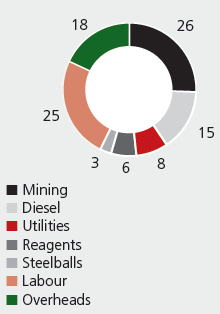 |
CHROME CONCENTRATE
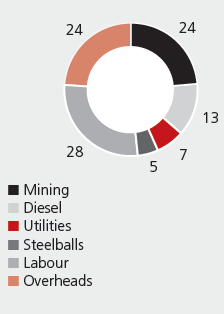 |
On a unit cost basis, the reef mining cost per tonne increased by 11.7% from US$18.8/t to US$21.0/t. This cost per reef tonne was incurred on a stripping ratio of 7.9 (m³ waste: m³ reef). On a per cube mined basis i.e. including both waste and reef, the cost increased by 3.8% from US$7.9/m³ to US$8.2/m³ (the prior year stripping ratio was 7.5).
Administrative expenses increased from US$26.9 million to US$39.2 million mainly due to an increase in employee costs which included certain bonus payments following the successful transition to an owner-mining model and costs associated with the employment of additional support staff (training, time and attendance, procurement, human resource and safety) necessary as an owner miner. After accounting for administrative expenses, the Group achieved an operating profit of US$72.5 million (2017: US$98.4 million).
The consolidated cash cost per tonne milled (i.e. including mining but excluding transport and freight) increased by 7.4% from US$34.9/t to US$37.5/t.
EBITDA amounted to US$101.9 million (2017: US$115.6 million).
Finance costs (totalling US$10.2 million) principally relate to the term loan and various OEM financing facilities due by Tharisa Minerals for the funding of mining fleet additions, the trade finance facilities of Arxo Resources and the limited recourse discounting of the PGM receivables.
The Group generated a profit before tax of US$65.0 million compared to the comparable period of US$91.0 million.
The tax charge amounted to US$14.0 million, an effective rate of 21.6%. The cash tax paid amounted to US$5.5 million. The Group has fully utilised its tax losses however, as at the year end, the Group had unredeemed capex for tax purposes available for off-set against taxable mining income of US$111.1 million. The net deferred tax liability amounted to US$28.0 million.
Basic earnings per share for the year amounted to US$19 cents (2017: US$ 22 cents) with headline earnings per share of US$ 19 cents (2017: US$ 22 cents). Diluted earnings per share were US$ 18 cents (2017: US$ 22 cents), with diluted headline earnings per share of US$ 19 cents (2017: US$ 22 cents).
The Group successfully closed the refinancing of the senior debt facility and the bridge loan facility (utilised to part finance the purchase of the mining fleet) with a three-year secured term loan of ZAR400 million as well as securing corporate facilities in the amount of ZAR400 million. Consequently, the amount held in the debt service reserve account is now available to the Group. The corporate facilities have not been drawn. In addition, US$37 million of financing facilities from original equipment manufacturers and asset backed facilities were arranged of which US$23.2 million was drawn at year end. Arxo Resources secured a US$20 million trade finance facility to fund pre-shipment chrome concentrate sales pipelines. As at the year end the facility was not yet accessed.
The total debt amounted to US$77.4 million, resulting in a debt to total equity ratio of 26.0%. This exceeds the long-term targeted debt to equity ratio of 15% principally due to the leveraged purchase of the mining fleet. Tharisa had cash and cash equivalent of US$66.8 million at year end resulting in a net debt to total equity ratio of 3.3%.
The current capex spend focused on stay in business capex, mining fleet additions to optimise the fleet and ongoing projects aimed at improving recoveries of both PGMs and chrome concentrates. Additions to property, plant and equipment for the year amounted to US$48.2 million of which US$23.4 million related to additions to the mining fleet including US$6.9 million related to right of use (leased) assets. This is in addition to the US$21.5 million paid for the acquisition of the mining fleet. The depreciation charge amounted to US$29.9 million (2017: US$16.9 million). The mining fleet was purchased from the mining contractor at a discount to the replacement value thereby having a favourable impact on the current depreciation charge.
The environmental rehabilitation provision was historically calculated based on the rates as prescribed by the DMR escalated by South African CPI. In the current year, the Group reviewed the basis of its estimates and judgements and the basis for the calculation of the environmental rehabilitation provision was amended to that of prevailing commercial rates.
The Company acquired a 26.8% shareholding in Karo Mining Holdings Limited for a cash consideration of US$4.5 million. This investment is accounted for using the equity method.
The Company has an option to acquire a 90% shareholding in Salene Chrome Zimbabwe (Private) Limited. It has a commitment to fund the exploration spend of up to US$3.2 million. This investment is accounted for as other financial asset at the cost of the exploration spend.
The Group generated net cash from operations of US$89.8 million (2017: US$75.7 million) and after taking into account the capex, a free cash flow of US$49.3 million (2017: US$53.1 million). Cash on hand amounted to US$66.8 million (2017: US$49.7 million).
There is continued focus on working capital management, with the current ratio at 2.0 times.
The Group has early adopted IFRS 9 Financial Instruments, IFRS 15 Revenue from Contracts with Customers and IFRS 16 Leases. The Group entered into a number of new lease agreements for the addition of mining fleet subsequent to 30 September 2017 and consequently decided to early adopt these standards. The early adoption resulted in negligible adjustments to retained earnings at 1 October 2017.
From time to time, the Group concludes transactions with related parties. These transactions are disclosed in the ensuing condensed consolidated annual financial statements (refer to note 23).
Dividend
In accordance with Tharisa's dividend policy of distributing at least 15% of annual net profit after tax, the Board has proposed a final dividend of US$ 2 cents per ordinary share subject to the necessary shareholder approval. The Company declared its first interim cash dividend during the year of US$ 2 cents per share.
Board appointment
Tharisa welcomed Zhong Liang Hong to the Board as a non-executive director with effect from 1 April 2018. Mr Hong represents Fujian Wuhang Stainless Steel Co., Limited and Huachuang Singapore Pte Limited, which respectively hold 7.44% and 1.98% of Tharisa's issued share capital with voting rights as at 30 September 2018.
Outlook
Our unique co-product mix, coupled with an open pit mine ensures we remain consistently at the low end of the production cost curve and, while we believe commodity prices will remain stable, we are well insulated against price volatility.
That said, fundamentals for the global stainless steel market support stable demand for chrome concentrates. Our specialty chrome products are in demand and given the premium pricing of this product, we benefit from strong margins.
The maturation of the business beyond the development stage has positioned the Group to implement the next phase of growth. The focus is not only on continuous improvements in feed grade and recoveries, but on expanding the business into new jurisdictions.
The production outlook for FY2019 is 160 koz of PGMs and 1.5 Mt of chrome concentrates, of which 375 kt will be specialty grade chrome concentrates. Our vision for 2020 is to produce 200 koz of PGMs and 2.0 Mt of chrome from the Tharisa Mine, on an annualised basis.
The management team is positive about the prospects for the year ahead and believes that with the various expansion plans, a strong focus on our mining division delivering quality ROM and managing the extensive yellow fleet to OEM standards, economies of scale will be demonstrated through reduced unit costs and increasing operating margins.
Ultimately, our success is measured by our consistent operational and financial delivery, and we have again set ourselves robust targets in line with our drive to grow this business. We are confident of meeting these as we deliver against our Vision 2020 strategy.
We thank our Board, management, employees, customers, suppliers and partners who have assisted the Company during this profitable year.